Cerebrium Achieves SOC 2 Type II Compliance for Secure Production AI Infrastructure

Connor Blier
Founding GTM

Cerebrium Achieves SOC 2 Type II Compliance for Secure Production AI Infrastructure
SOC 2 Type 2 is about much more than passing an audit
In the first wave of AI adoption, most companies accessed intelligence through hosted APIs. They sent prompts to external model providers, received responses back, and treated AI as another software integration.
That is changing. More companies are now deploying proprietary models, fine-tuned LLMs, customer-facing voice agents, autonomous coding systems, and healthcare copilots that process sensitive data inside their organizations. As AI moves closer to core business operations, the infrastructure around it has to meet a higher standard.
Performance still matters. Nobody wants an inference platform that adds hundreds of milliseconds of latency or takes minutes to cold start. But for production AI, latency is only one part of the equation. The platform also has to prove that customer code, model weights, secrets, logs, and infrastructure are being managed securely, especially as companies move to internalize more of their intelligence architecture.
52% of organizations cite sensitive data exposure as their primary security risk, far outweighing AI-specific threats like prompt injection.
That's why we're excited to announce that Cerebrium has successfully completed its SOC 2 Type 2 audit. Rather than simply announcing another compliance certification, it's worth discussing why this matters for the next generation of AI applications.
Production AI Requires More Than Fast GPUs
When cloud computing emerged, infrastructure providers were often evaluated on reliability, performance, and cost. Those things still matter. But AI infrastructure now sits closer to the intelligence layer of the business.

A production inference platform may handle proprietary models, fine-tuned weights, system prompts, customer prompts, retrieval context, agent workflows, voice transcripts, evaluation data, and logs that reveal how the product actually works. These are not just operational assets. In many cases, they are part of the company’s competitive advantage.
Traditional infrastructure has always been responsible for protecting sensitive data. What is different now is that AI systems often concentrate sensitive data, product logic, and business-specific intelligence in the same runtime. As models become easier and cheaper to build, the durable moat increasingly comes from the data, workflows, context, and deployment architecture around them.
That changes what companies should expect from an AI infrastructure provider. Fast GPUs, low latency, and competitive pricing are necessary, but they are not enough. The platform also has to prove that it can protect the proprietary intelligence that makes the AI system valuable.
Simply put, production AI is not just a performance problem. It is also a security, trust, and intellectual property problem. Securing the infrastructure that powers it is now just as important as optimizing the models themselves.
The AI Procurement Landscape Has Changed
AI adoption is maturing as well. According to McKinsey's 2025 State of AI survey of nearly 2,000 business leaders across 105 countries, 88% of organizations now use AI in at least one business function. Notably, 71% of respondents work at organizations generating more than $100 million in annual revenue, reflecting how AI has moved well beyond startups and experimentation into established enterprises.
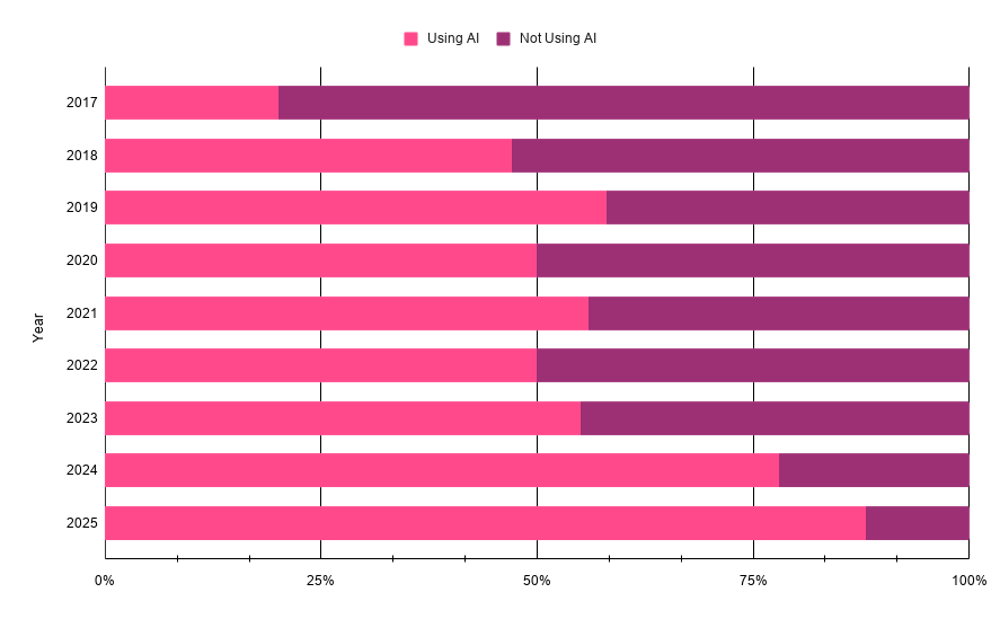
As AI becomes part of core business operations at larger companies, it is also moving into more sensitive environments. Rather than generating marketing copy or answering internal questions, it's increasingly processing patient records, financial data, proprietary source code, legal documents, customer conversations, and other business-critical information. As both the buyers and the workloads mature, the expectations placed on AI infrastructure change with them.
The result?
The engineering team may still decide which inference platform they prefer. But Legal decides whether it can be used, Security decides whether it can be deployed, and Procurement decides whether the contract gets signed. Many AI infrastructure purchasing decisions now begin with security questionnaires before engineers ever benchmark latency.
Why SOC 2 Type 2 Matters
SOC 2 reports are often misunderstood. A Type 1 answers:
Did the company design appropriate security controls?
A Type 2 answers:
Did those controls actually operate effectively over time?
Over an independent audit period, auditors evaluate whether operational processes consistently functioned as intended - not simply whether policies existed on paper. For Cerebrium, that resulted in included controls around:
Infrastructure security
Encryption at rest and in transit
Multi-factor authentication
Least-privilege access
Secure software development
Production change management
Incident response
Continuous monitoring
Vendor oversight
Risk management
Our security report also noted that no significant system incidents occurred that prevented Cerebrium from meeting its stated security commitments during the audit period. For customers, that's meaningful because it demonstrates operational maturity rather than documentation alone.
Security Shouldn't Cost You Performance
One misconception in infrastructure is that security inevitably introduces friction. At Cerebrium, we've always believed the opposite. The same engineering discipline that delivers low latency and reliable autoscaling is the discipline that produces secure systems.
Our customers rely on Cerebrium because they need infrastructure capable of serving production AI workloads globally with predictable performance.
That includes:
Serverless GPUs
Dedicated inference endpoints
Multi-region deployments
Global request routing
Rapid scale-to-zero recovery
High availability
SOC 2 Type 2 demonstrates that the operational systems supporting these capabilities have been independently evaluated over an extended period. Not just implemented, but consistently executed.
Infrastructure Is Trust
The first generation of AI applications consumed intelligence through APIs. Companies sent prompts to hosted models, received responses, and moved on. The infrastructure itself wasn't particularly strategic because very little proprietary information lived there.
That has changed.
Today's frontier AI companies increasingly serve their own models and build AI systems that retain context, access internal knowledge, and automate critical business processes. The infrastructure running those applications now stores proprietary model weights, customer code, application logs, secrets, uploaded documents, and, in many cases, highly regulated data. It's no longer just compute - it's building a competitive moat around proprietary function which relies upon anorganization's security boundary.
For years we've focused on delivering the performance customers need to run production AI, achieving 99.99% uptime while serving latency-sensitive workloads around the world. Earning SOC 2 Type 2 reflects that same commitment to operational excellence. Reliability and security aren't separate goals - they're two sides of the same promise we continue to deliver upon to our customers.
If you're evaluating Cerebrium for production AI workloads, we're happy to walk through our security program in detail. Our full SOC 2 Type 2 report is available to prospective customers under a mutual NDA, and our trust center can be found here. Reach out to our team anytime, we're happy to share it and answer any questions about how we protect your workloads.